|
|
|
Residual stress measured in a known stress bent beam
This is a very nice validation of the slitting method and also an excellent way to make a known stress specimen.
Schajer, G. S., and Prime, M. B., 2006, "Use of Inverse Solutions for Residual Stress Measurements," Journal of Engineering Materials and Technology, 128(3), 375-382. preprint (pdf). (LA-UR-04-5890)
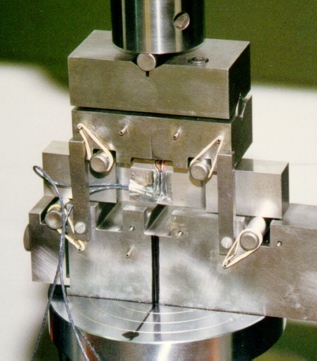
Beam Specimen:
- 21Cr-6Ni-9Mn austenitic stainless steel (Nitronic 40)
- 30 mm height by 10 mm wide in gauge section
- Bent in 4-point bending into plastic region and unloaded
- Strains and loads measured during bending
- Loading and unloading stress-strain curves calculated from strain and load data during bending
- Mayville, R. A. and Finnie, I., “Uniaxial Stress-Strain Curves from a Bending Test,” Experimental Mechanics, 22, 197-201, 1982.
- Loading and unloading curves superimposed to calculate residual stress
- *** There was a Bauschinger Effect - so it is important to measured unloading curves
|
 |
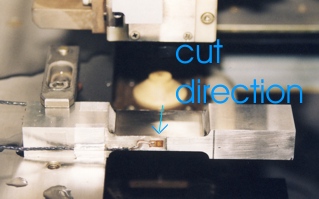
Cut slot using wire EDM:
- Cut slot using 200 µm diameter Brass wire
- 36 cut depths to a final depth of 29.26 mm (97.5% of beam thickness)
- Submerged in de-ionized water during cutting
- Strain at each depth was measured with strain gage on back surface (EDM machine turned off for measurement)
|
 |
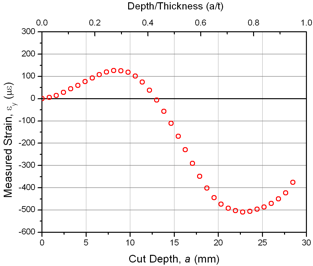
Strain Data:
- Strain measured on back face strain gage for all 36 depths of cut
- Data is available in this text file.
|
 |
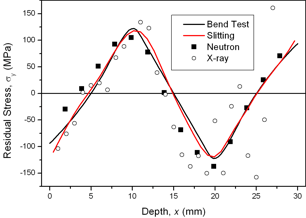
Pulse Results :
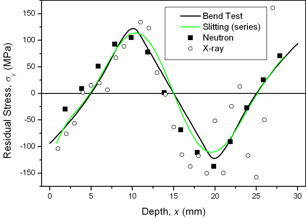
- Excellent agreement with known stress
- These results use the "pulse" stress functions and regularization as described in
- Schajer, G. S., and Prime, M. B., 2006, "Use of Inverse Solutions for Residual Stress Measurements," Journal of Engineering Materials and Technology, 128(3), 375-382. preprint (pdf). (LA-UR-04-5890)
- Compared here with stresses measured by neutron diffraction and surface x-rays as described in
- M. B. Prime, P. Rangaswamy, M. R. Daymond, and T. G. Abeln, "Several Methods Applied to Measuring Residual Stress in a Known Specimen," Proc. SEM Spring Conf. on Experimental & Applied Mechanics, Houston, Texas, June 1-3, 1998, pp. 497-499. 101K pdf. (LA-UR-98-0904)
|
 |
Series Expansion :
- Slitting results using conventional series expansion as described in theory page
- Used Legendre polynomials order 2 and up (order 0 and 1 do not satisfy equilibrium)
- This is an 8 term series (orders 2-9). Order selected based on minimizing uncertainty
- Prime, M. B., and Hill, M. R., 2006, "Uncertainty, Model Error, and Order Selection for Series-Expanded, Residual-Stress Inverse Solutions," Journal of Engineering Materials and Technology, 128(2), pp. 175-185. preprint (pdf). (LA-UR-05-2597)
|
 |
Strain Fit:
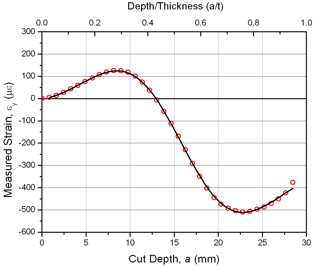
- This is how well the stress results above fit the measured strain data
- Root-mean-square misfit is about 6 microstrain, and most of that is from the last data point
- A higher order fit will the last data point, but is too unstable
- You should always plot this strain fit to see how well your solution is performing
|
|
NOTE: The raw data from this test and any other data from published
results can be made available for research purposes. Just email
me. |
|