Los Alamos National Laboratory The Slitting Method for Residual Stress Measurement:  : Mesocale stresses in Additive Manufactured Part
 

Mesocale stresses in Additively Manufactured Ti-6Al-4V

Strantza, M., Vrancken, B., Prime, M. B., Truman, C., Rombouts, M., Brown, D. W., Guillaume, P., and Van Hemelrijck, D., 2019, "Directional and oscillating residual stress on the mesoscale in additively manufactured Ti-6Al-4V," Acta Materialia, 168, 299-308. https://doi.org/10.1016/j.actamat.2019.01.050. preprint (pdf).

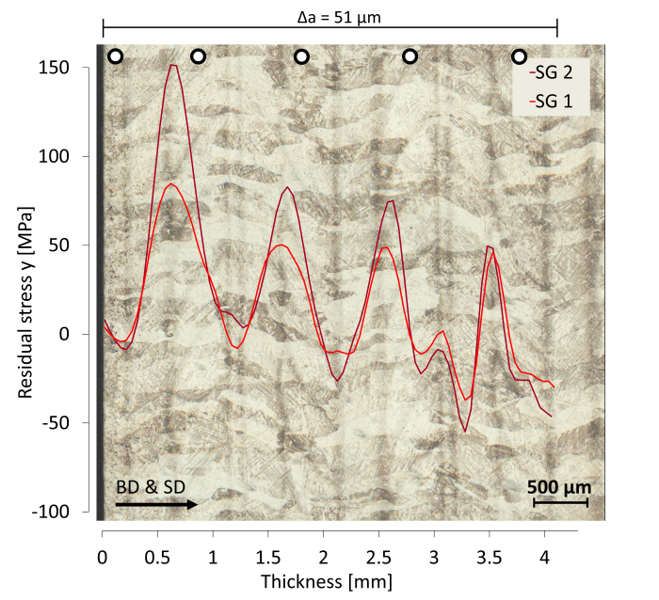
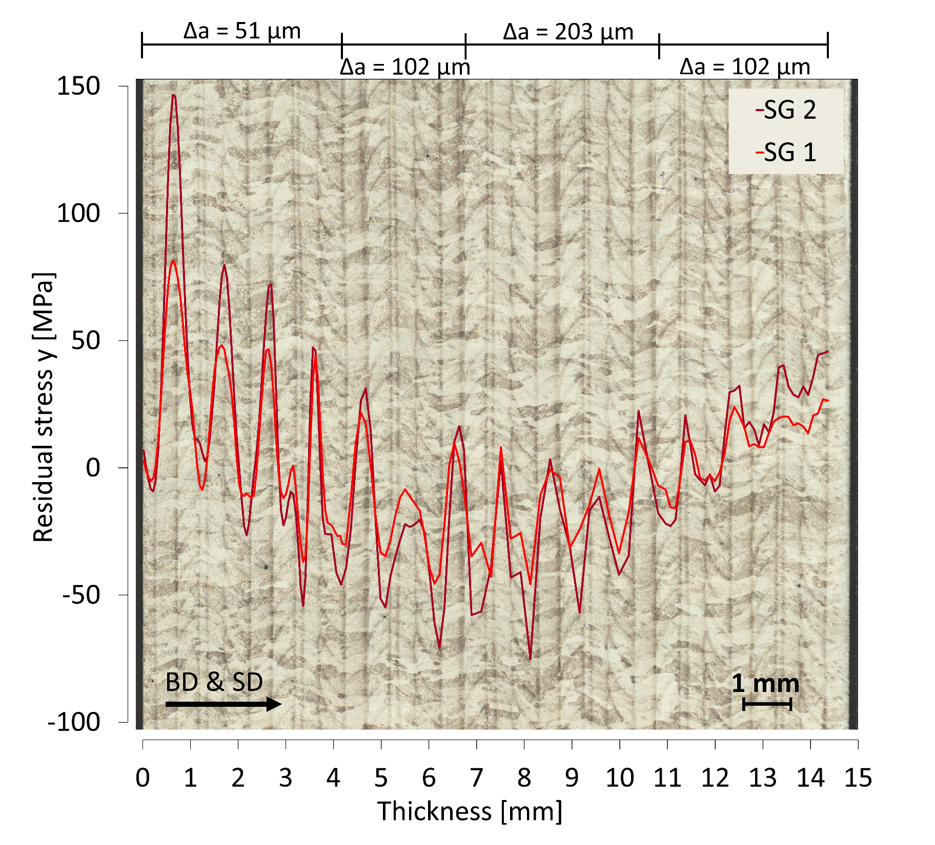
RESULTS: First ever measurement of layer to layer stress oscillations in AM part

  • Unprecedented resolution of oscillating stresses on the mesocale!
    • The scale of the 0.5 mm thick build layers
  • In fact, we were able to reslve the oscillations over nearly 30 layers:

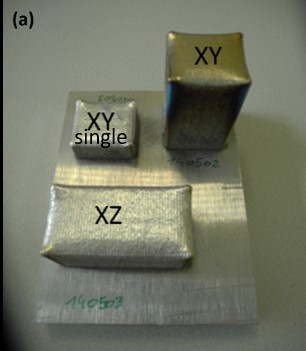
Titanium AM specimens:

  • Ti-6Al-4V
  • Produced with Laser Metal Deposition process
  • The contour of each layer was deposited first and then filled via a continuous bidirectional scan strategy with a spacing of 600 µm between neighbouring scan tracks
  • The layer thickness was 500 μm and the scanning direction of successive layers was rotated by an angle of 90°


Most slit depth increments ever for a sliting measurement:

  • 161 total increments
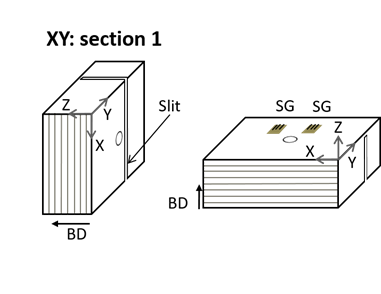
  • Cut slot using 100 µm diameter brass wire
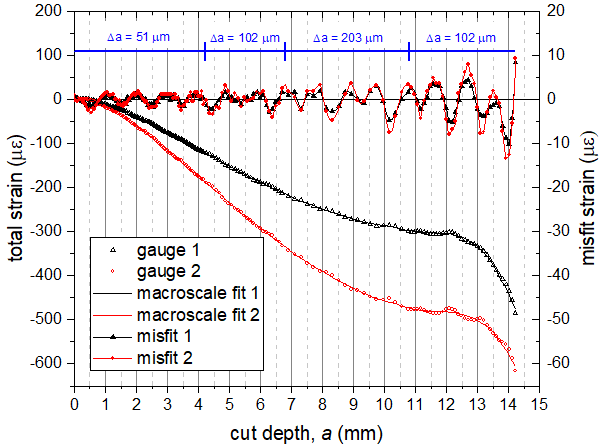
  • Slot cut in 51 µm increments (0.002") initially, then coarser
  • Strain at each depth was measured with strain gage on back surface opposite the cut

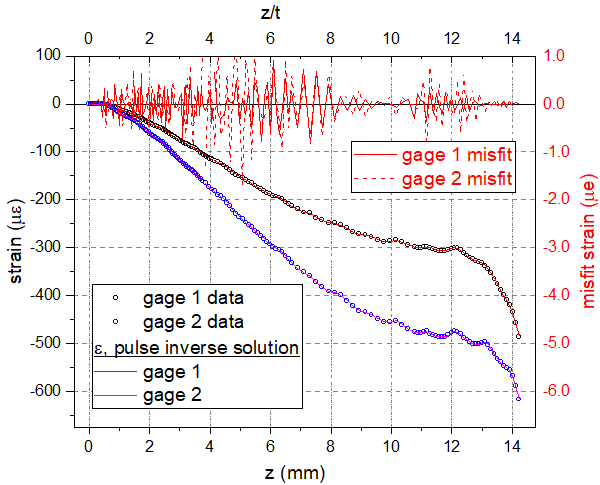
Strain data shows mesoscale:

  • Strains show long scale variations: strains tend towards compression
  • Looking closely, there is superimposed a sinusoidal variaiton at 1 mm wavelength
  • Can see this by fitting macroscale variation with smooth curve and then plotting misfit to data
  • Strains alternate every 0.5 mm: the size of the build layers

Only "pulse method" able to fit data:

  • These are the strains that result from the stress results at the top of the page
  • Quality of inverse solution for stress can be judged by how well it fits (reproduces) strain data.
  • This stress variation cannot be well fit using series expansion
    • Because of mesoscale variations
  • Was able to fit well using "pulse" method.
    • Misfit between inverse solution and data is mostly less than 1 microstrain - just noise!